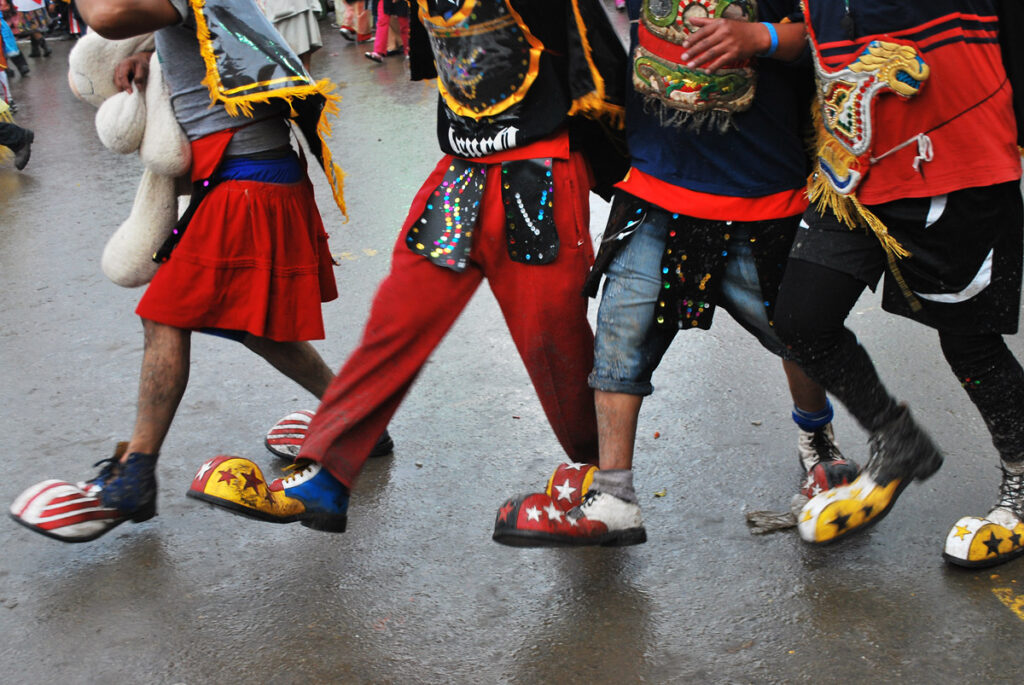
Source: Francisca Casas-Cordero
Written by
Consuelo Cerda Monje, PhD in Arts and Education
March 3, 2026
In the current context of polycrisis—understood not as the mere sum of isolated crises but as a relational web of ecological, economic, geopolitical, technological, and democratic collapses that reinforce one another (Morin & Kern, 1993; Helleiner, 2024)— culture emerges as a strategic terrain of dispute, and it becomes necessary to place it at the center of international public debate.
Thus, culture should not be approached as a peripheral domain in contrast to the “material reality” of crises, but rather as one of the sites where the imaginaries that sustain them are produced, legitimized, or contested. If polycrisis expresses a civilizational crisis of modern capitalism—marked by extractivism, inequality, and the erosion of the commons (Svampa, 2016; Escobar, 2019)—then culture constitutes both a field in which hierarchies and sacrifice zones are naturalized and a space from which other forms of life and other modes of relating to the world are rehearsed. Within it, models of development, notions of progress, and conceptions of humanity are confronted; within it as well, practices emerge that rearticulate memory, produce community, and dispute hegemonic meanings. In this framework, culture can become a site of resistance, civilizational transition, and a structural condition for democratic life.
Since the MONDIACULT 2022 Declaration and its updates in MONDIACULT 2025, UNESCO has clearly reiterated that culture is a global public good: a fundamental right, a strategic resource for sustainable development, and a constitutive dimension of human dignity. This assertion implies displacing culture from the accessory or ornamental sphere in order to understand it as infrastructure of meaning, as a matrix of coexistence, and as a condition of possibility for social cohesion. Or, as Gilberto Gil (2003) challenges us, as part of our “basic survival basket.”
However, as Jazmín Beirak warns in Cultura Ingobernable (2022), culture is not a docile object that can be administered without tension. It is a field traversed by disputes, by forces that seek to instrumentalize it, and by practices that overflow it. Eduardo Nivón (2025) reminds us that every cultural policy implies a position regarding which practices are legitimized, which memories are preserved, and which ways of life are considered valuable. Tomás Peters (2020) further complicates the panorama by showing that cultures are not homogeneous entities but multiple, dynamic, and conflictive assemblages that structure everyday experience.
If we accept, then, that culture is a field of dispute, structured by political decisions about legitimacy and value, and configured by multiple and conflictive networks, the question ceases to be only what we understand by culture and becomes how its recognition is socially produced. That is, through which dispositifs, experiences, and practices do we learn to perceive the common, to value difference, and to inhabit diversity as a constitutive condition?
At this point, education becomes a decisive terrain. If culture is a public good, access to and appropriation of it cannot depend exclusively on consumption or inherited cultural capital, but rather on formative processes that enable experiences of participation, interpretation, and creation. From this perspective, the relationship between art and education becomes a strategic space for materializing culture as a common good. It is not a matter of art “illustrating” content nor remaining confined to the professional- disciplinary sphere, but of becoming an epistemological foundation of learning: a way of producing knowledge, constructing public sensibility, and sustaining social cohesion.
In this sense, artistic practices—and particularly dance and the performing arts—operate as producers and mediators of knowledge. They produce modes of perceiving, relating, and inhabiting the world. Addressing them in education does not mean adding isolated subjects, but enabling forms of learning that integrate sensibility, critical thinking, embodied memory, and collective experience.
The performing arts have historically been at the heart of popular culture: in festivities, rituals, carnivals, processions, political demonstrations, and community celebrations. There, movement organizes collective memory and produces belonging. When these practices enter the pedagogical space from a critical perspective, they diversify ways of understanding the world and its cultural references, while questioning hierarchies of knowledge.
From this perspective, the body becomes a living archive of memories and experiences. Leda María Martins (2019) has shown how Afro-diasporic corporealities transmit memories, temporalities, and cosmologies that do not always find a place in official narratives. The body preserves, updates, and recreates histories. Movement thus becomes a space of re-existence: a way of sustaining life, dignity, and memory in the face of exclusionary logics.
If education assumes culture as a public good, it must recognize that knowledge does not circulate solely through verbal or written language. It also circulates in gestures, rhythms, displacements, and ways of relating. Artistic practices within the curriculum allow these forms of knowledge to enter into dialogue with other epistemological frameworks, broadening the horizon of what we consider legitimate to learn.
Therefore, in our current scenario of multiple civilizational crises—where the ecological, democratic, and symbolic foundations of collective life are being eroded—understanding culture as a public good requires more than institutional declarations. The relationship between art and education expands expressive repertoires and, at the same time, reconfigures the very conditions of the common. By recognizing the arts—in their diverse disciplines—as legitimate forms of knowledge, we affirm that every corporeality bears memory, that every experience can become knowledge, and that diversity is not the exception but the structure. There, culture ceases to be abstract discourse and becomes shared practice; education ceases to reproduce hierarchies and begins to rehearse other forms of coexistence. In this intersection—between culture as a right and art as pedagogical mediation—the democratization of symbolic access and the very possibility of imagining civilizational transitions in the face of the relational density of contemporary crises are at stake.
References
Beirak, J. (2022). Ungovernable culture: On culture as a tool for social transformation. Debate.
Escobar, A. (2019). Feeling-thinking with the Earth: New readings on development, territory and difference. Universidad del Cauca.
Gil, G. (2003). Inaugural speech as Minister of Culture of Brazil. Ministry of Culture of Brazil.
Helleiner, E. (2024). The polycrisis of economic globalization. Cambridge University Press.
Martins, L. M. (2019). Performances of spiral time. Cobogó.
Morin, E., & Kern, A.-B. (1993). Terre-Patrie. Seuil.
Nivón Bolán, E. (2013). When culture is the object of policy. Siglo XXI Editores.
Peters, T. (2020). Sociology of cultures. Ediciones Universidad Alberto Hurtado.
Svampa, M. (2016). Latin American debates: Indigenism, development, dependency and populism. Edhasa.
UNESCO. (2022; 2025). MONDIACULT 2022; 2025: Final Declaration. World Conference on Cultural Policies and Sustainable Development. UNESCO.
__________
Consuelo Cerda Monje is a researcher, cultural manager, and dance artist. She holds a PhD in Arts and Education from the University of Barcelona. Her work brings together culture, education, and cultural policy from a critical and situated perspective bridging Latin America and Europe. Her research explores the body as a living archive and performative pedagogies. She develops international cultural cooperation projects linking the performing arts, education, and territory.