Interview with Karin Weil González
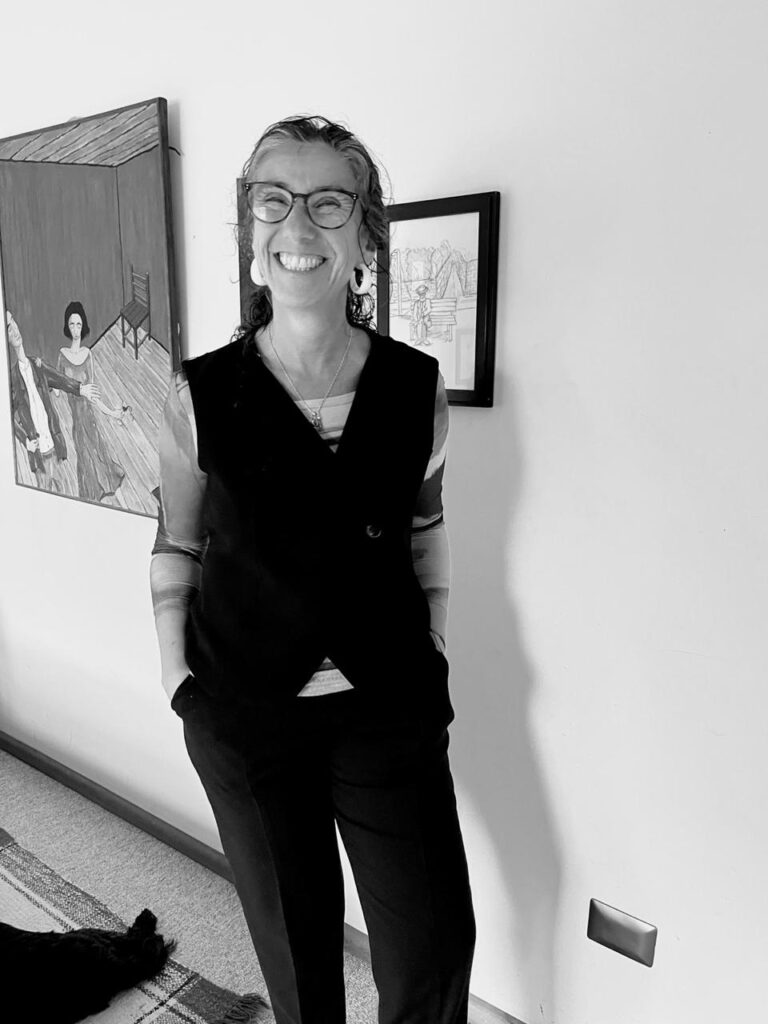
Written and interviewed by Francisca Casas-Cordero, ISGlobal
June 2, 2026
Between community museums in southern Chile and European debates on cultural diversity, Karin Weil González has spent decades exploring an important question: who has the right to decide which memories matter, and how they should be told. A social anthropologist, heritage specialist and current Regional Director of the National Cultural Heritage Service (SERPAT) in the Los Ríos Region of Chile, Karin is also a member of the PULSE-ART Advisory Board. In this conversation, we reflect on memory, heritage, creative processes and the challenges of building a shared common ground in the midst of diversity.
To begin with, I would like you to tell us a bit about your trajectory and the main lines that shape your work.
I think coming from southern Chile, rather than from the metropolitan centre, already makes a difference. I studied social anthropology at a university that, although private, had a strong public vocation closely connected to the needs of southern territories. That was very important for me, because I trained in the early 1990s, in a post-dictatorship context, in a territory deeply marked by cultural diversity.
From my training as a social anthropologist, my work has focused on facilitating community processes, from diagnosis to the creation of social programmes. A foundational experience was the two years I spent living on Easter Island, where I carried out my thesis on the impact of tourism on cultural elements. That experience strongly shaped my sensitivity towards territorial diversity.
I have worked with rural communities, Mapuche communities, and also within programmes addressing informal settlements in southern Chile. Over the last twenty-five years, this community-based approach has become increasingly specialised through heritage and museums. I have led research, curatorial and community-based museum projects across several regions of southern Chile.
Today, I find myself on the other side, within state institutions. I currently serve as Regional Director of the National Cultural Heritage Service in the Los Ríos Region, which allows me to work in two directions at once: bringing situated territorial experience into public policy, while also understanding how the State can work more effectively with communities.
At the centre of all this are forms of heritage understood not as isolated objects, but as diverse ecosystems — material and immaterial, natural and cultural — intertwined in ways that give meaning to who we are.
From your perspective, how does the concept of Cultural Awareness and Expression — which lies at the core of the PULSE-ART project — relate to questions of memory and heritage?
I believe memory is fundamental. If we understand it as something that transcends the individual, then it is what allows us to comprehend diversity in our condition as social beings. Although culture is an essential human characteristic, memory is what gives us the capacity to construct a narrative that goes beyond the “pure” historical fact.
There is a phrase that may sound cliché — “all stories matter” — but its value lies precisely in the fact that memory allows us to inhabit history beyond objective data. A historical event may be global and concrete, such as what September 11 represents in Chile or the United States, but diversity lies precisely in how we remember it, how that memory changes over time, and how we experience it in relation to reality.
It is through that process that we build a sense of belonging. Through a shared or consensual memory, we define what is common and collective; this is where what we call heritage and identity emerge. For me, cultural awareness is inseparable from the recognition of memory. And I am not speaking only about something emotional or affective, but about something structural that constitutes us and ultimately allows us to understand who we are.
This immediately raises another question for me: how can memory be worked with in diverse contexts, for example in classrooms where children from different cultural backgrounds coexist?
That is one of the major challenges today, especially in childhood and adolescence. We live in a deeply adult-centred culture where adults define what has value and what should be remembered, often rendering younger voices and perspectives invisible. Becoming aware of that diversity within the classroom is precisely what allows us to begin constructing a shared space.
Although my experience is not directly classroom-based, I observe that even in events such as Chile’s Heritage Day, programming is usually imposed from our adult perspective. We rarely ask children what they themselves value or what they wish to propose. In a diverse classroom — with children from Morocco, Ukraine or Chile — diversity itself becomes the first point of encounter. Sharing a space while being different, carrying different historical origins and meanings, already creates a common ground from which something shared can begin to emerge, especially through language.
I remember an experience in a rural school where Mapuche children were playing the trompe, a traditional instrument. There happened to be children from Sweden and Mongolia who recognised the instrument because their ancestors also used it. Those unexpected connections only emerge when we allow ourselves to talk and truly get to know one another.
In the end, it is not about children recognising something that already exists “in common”, but about actively creating it together. Dialogue and listening are the only processes that allow diversity to settle into something shared.
Thinking about that need for dialogue and listening: is it really possible to work collectively in contexts marked by inequality, for example when facilitating artistic or creative processes?
We know that singing, theatre, dance — creative processes in general — allow us to let go. And I think what matters there is not whether the outcome becomes a famous artwork or something spectacular, but whether the process allows us to flow and move from the individual experience towards a collective one.
When you work from the experiences, stories and memories that each person carries with them, you begin to create a collective. And that generates a sense of belonging and community, perhaps even despite our differences. Because ultimately these processes allow us to show ourselves, but also to listen to and understand others — where they come from, and at the same time where I come from and who I am.
And I think that is the most interesting part: understanding that this is not about erasing differences or making everyone the same. Diversity is often imagined in a very idealised way, but in reality diversity also involves inequalities, different temporalities, different languages and different ways of inhabiting the world.
That is why I believe it is methodologically crucial to create genuine spaces for listening. So often we want to move quickly, produce results and meet objectives, but in doing so we lose something fundamental: human connection.
And I honestly think that sometimes less methodology is more. Because when people manage to listen to one another, share vulnerabilities and recognise themselves through their differences, that is when something truly collective begins to emerge.
I also think this has a lot to do with how we learn. Today we live trapped within highly individualistic dynamics and disconnected from direct experience. By contrast, when we observe, listen to and pay attention to territory, nature and human relationships, other forms of learning emerge.
I experienced this myself while working in wetlands. Understanding how communities observed birds in order to recognise climate changes or natural cycles makes you realise how much knowledge we have stopped paying attention to. Creative processes have precisely that potential: they allow us to observe again, to listen again, and to collectively build from our differences without erasing them.
Finally, returning to your experience in museums and heritage work: what do you see today as some of the main challenges these institutions face in relation to cultural diversity?
Well, it is a contested field. Today there is much discussion around decolonisation and new museology, concepts that take us back to the Santiago Roundtable of 1972, where there was an attempt to move the object away from the centre in order to prioritise the subject and lived experience. However, in practice, the museum still operates as a structure of power: it determines who has the right to tell a story and how that story should be told. And I have witnessed this contradiction very closely.
Today many Indigenous communities wish to create their own museums, but they experience a profound incoherence between the traditional institution and their own needs. For many Indigenous peoples and communities, memory is not a written archive or an inventory of objects; it is living orality.
Recently, I met with a community leader who wanted to preserve that oral memory because elders are passing away and, with them, entire worlds disappear. What is fascinating is that younger generations today feel proud of that history — something that did not happen before because of stigma.
The problem is that public policy remains colonial. For the State to officially recognise a museum, communities are required to preserve physical objects under rigid technical standards for years. This ignores the fact that, within a community, an object may hold no archaeological or scientific value for the Louvre elite, while at the same time being the very heart of that community’s territorial identity.
We need to transform public policy so that archaeological findings are not understood merely as “study material”, but as living histories that continue to hold meaning for people today. The underlying question is political: what is historical value, really? Is it the inert object inside a display case, or the oral memory that keeps it alive within the community?
If we fail to question that canon, then we are simply reproducing exclusion under a more modern name.