
Image source: Designed by Theodosia Bitzou of FORTH Institute of Computer Science
Written by Pamela Blanche, ISGlobal
June 2, 2026
What is the PULSE-ART Observatory?
The PULSE-ART Observatory is a digital platform that brings together tools, resources, and networking opportunities for art-based learning. Its resources are designed to develop Cultural Awareness and Expression (CAE) — one of the eight Key Competences for Lifelong Learning defined by the European Union (2019).
The Observatory’s toolkit draws on the findings, co-creation processes, and implementation outcomes of the PULSE-ART European research project (2024–2027). The platform is built on the FAIR & CARE principles: open, interoperable, and community-driven.
Why does it matter?
The Observatory for Arts in Education brings together research-grounded resources and practical tools from the PULSE-ART project, offering knowledge, competences, and perspectives to support a pedagogical approach known as art-based learning. This educational approach uses artistic and cultural practices as a vehicle for generating knowledge and critical thinking, fostering forms of learning that are reflective, sensitive, and contextually situated. Within the PULSE-ART framework, it is specifically oriented toward strengthening CAE.
Who is it for?
The Observatory is open to anyone with an interest in art-based education, CAE, cultural diversity, or youth participation, including educators, artists, NGOs, researchers, policymakers, professionals from the creative industries, and engaged citizens.
What does it offer?
The Observatory functions as an open-access* repository with four main areas:
- Resource library. A curated collection of academic literature, policy documents, and best practices, filterable by artistic discipline, theme, and competence.
- Toolkit. A set of practical instruments, including a Competence Framework for Educators and Learners, a Professional Development Programme for Educators, a Self-Reflection Tool (SRT) to track learning progress, and a Case Study Methodology currently being tested and adapted across seven case studies.
- Seven case studies. The methodology will be implemented across seven case studies in Europe and Morocco, engaging young people aged 16–30 through a range of artistic disciplines: game jams, video games, performance, illustration, dance, visual arts and technology, and music. The Observatory will serve as a repository for case studies’ process and resources, displaying the diversity of their implementation.
- Community. A space for connection and potential collaboration, featuring an interactive map of stakeholders, webinars, and a member directory.
Some resources and features are still under development. It is worth noting that the PULSE-ART Toolkit will be refined throughout the project, capturing contextual and cross-country variations to produce richer, more robust tools available at the project’s close.
*Registration is required to access the above mentioned repository.
What is the methodology for developing the Observatory?
The Observatory was first launched in October 2025. An initial co-creation and participatory process involving 43 end-users, PULSE-ART stakeholders from Greece, Spain, and Morocco, was conducted in three workshops in December 2025 to co-design it. During these workshops, the project team researched the stakeholders’ needs, expectations, and platform behavior, as well as resource and digital reference formats for the user experience. A subsequent qualitative analysis identified cross-cutting patterns among the three countries and developed guidelines for the platform’s architecture, functionalities, and content.
Currently, the technical team is applying these guidelines to improve the digital experience for end-users. The PULSE-ART team expects to continue optimizing the Observatory’s resources and tools by encouraging active community participation and feedback on the platform and by implementing the seven case studies.
The platform was recently presented at the 1st Global Digital Rights Forum on May 14th in Barcelona. The forum was organized by Mobile World Capital. Marine Masson, coordinator of PULSE-ART (Science for Change), participated in the session “Art, Creativity, and Democracy in the Algorithmic Age,” where she showcased the Observatory’s new functionalities and progress.
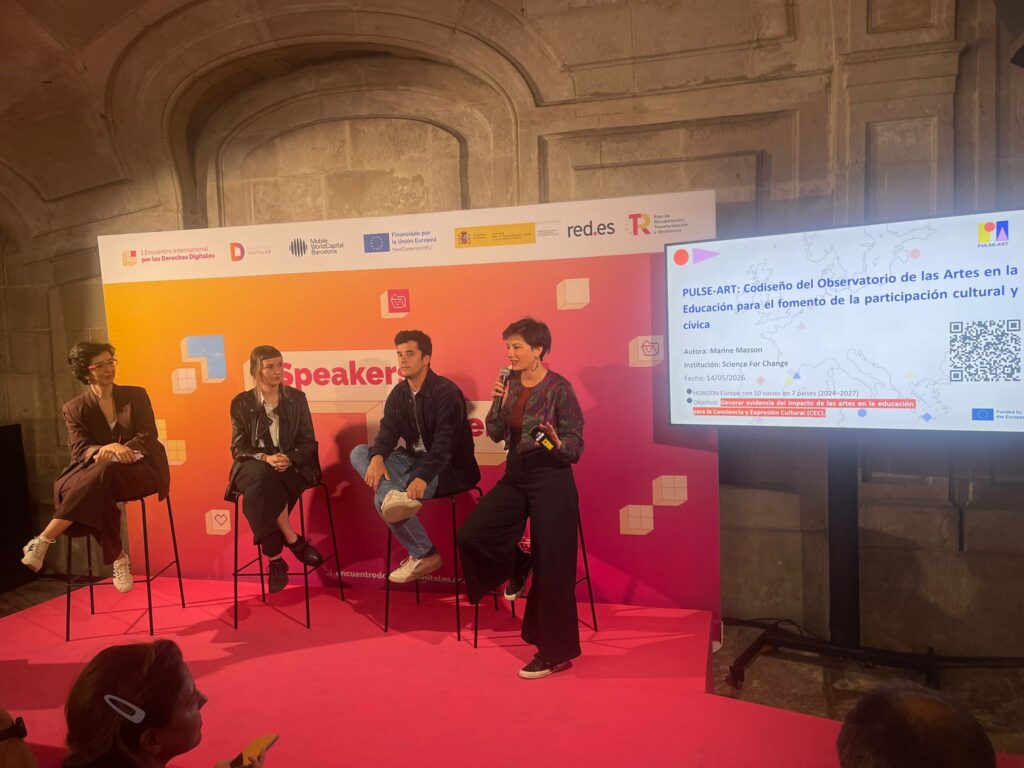
PULSE-ART in the 1st Global Digital Rights Forum, Barcelona, 14/05/2026
Image source: PULSE-ART
Explore the platform where arts and education converge. Visit us, participate, and join the community!