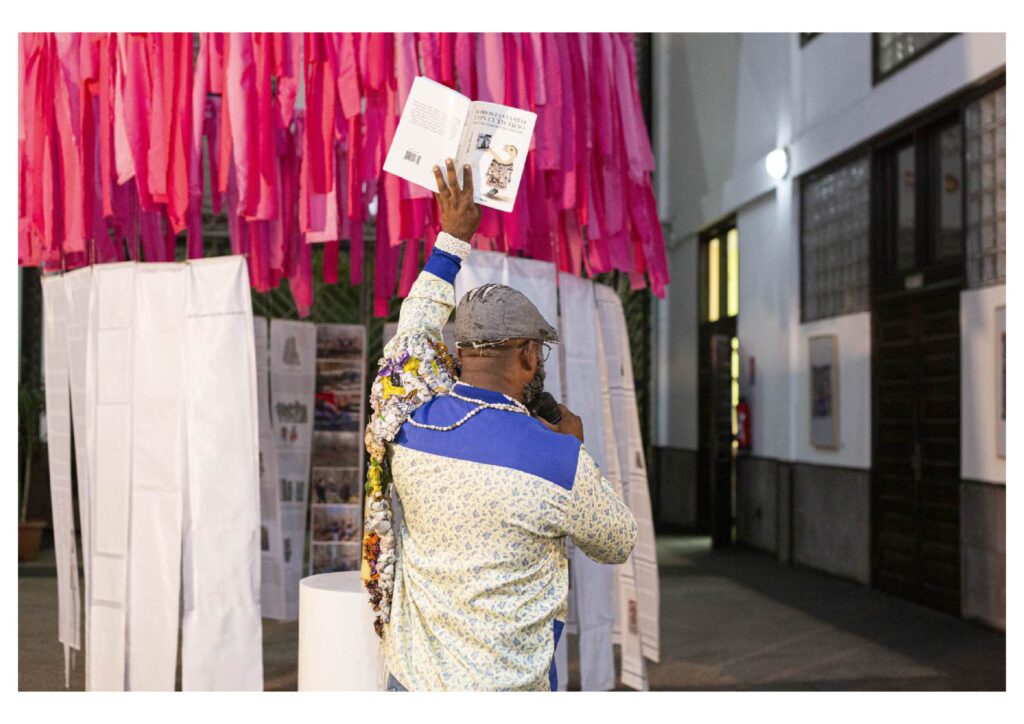
Performance by artist Bësákkò Bià Rihólè during the opening of the exhibition Póchó Guimarães. Malabo y las obras que hablan [Malabo and the Works That Speak]. Courtesy of the Centro Cultural de España en Bata (CCEB), 2026.
Written by Laura José Iserte
October 6, 2026
On Friday 4th September, we opened one of the major exhibitions in our annual exhibition programme. We invested considerable energy and care in the opening: we allocated a larger budget, brought works over from Spain and developed a carefully crafted communications strategy. It was also a monographic exhibition dedicated to Póchó Guimarães, a very well-known and widely appreciated artist in Equatorial Guinea. Yet fewer people attended than we had expected.
We could interpret the absence of a “full house” as a lack of interest or of established cultural habits. Alternatively, we could question whether the activation format itself was appropriate. What if the problem were not how to get more people to attend our openings, but our insistence that the opening should be a socially significant occasion? Why should an opening be the moment through which we expect a community to develop a relationship with an exhibition?
When I moved to Equatorial Guinea, knowing that the Centro Cultural de España en Bata (CCEB) was one of the few active cultural centres in the country’s continental region, I assumed that it would quite obviously reach a broad public. Over time, I have come to think that this initial premise may say more about my own expectations of what a cultural centre should be than about the place in which it operates. In other words, I took the centrality of the cultural institution for granted.
Working in a situated way is not simply a matter of adapting our projects to a different context. It involves learning to recognise the cultural expectations embedded in our own methods of programming, mediating and evaluating.
Programming
Working within a Spanish cultural institution in Equatorial Guinea requires us to ask from what position we programme—a position shaped by a colonial past and by material and symbolic asymmetries. Even the well-intentioned desire to “give space” can reproduce a vertical relationship if we are the only ones who decide what space is available, when, and on which terms.
The case of this exhibition makes the question even more uncomfortable. This was not an exhibition detached from its context, nor was it devoted to an artist brought in from elsewhere: we were dedicating one of the year’s major exhibitions to an Equatoguinean artist. Situated programming, then, may not be resolved solely by considering what or whom we programme. It also requires us to ask how we do it, through which formats, and what kind of relationship we expect audiences to establish with what we programme.
I feel that this same questioning pushed us to try out different formats, still on a fairly experimental basis: guided tours, talks, workshops… The results do not always align with what I would have expected. A visit to an exhibition led by the artist, for example, may appear to have great potential to draw an audience and yet fail to achieve the expected impact. Workshops, by contrast, tend to be very well received. I do not think this allows us to conclude that one format “works” and another does not, but it does require us to revisit some of the expectations with which we programme them.
I also find it useful to reconsider the place occupied by the exhibition itself within the programme. In July, for example, the Moa Mboka, an urban culture festival featuring freestyle battles, breakdancing, concerts and other activities took place at the CCEB. We decided that the exhibition running during that time should dialogue directly with the festival and, after landing the idea with the artist Sol Bela Mele, the urban fashion photography exhibition When Life Feels Good happened.
Rather than placing the exhibition as the centre of the public programme and then building activities around it, we tried the reverse: starting with what was already happening in the programme and enabling the exhibition proposal to enter into dialogue with it. In this case, the relationship worked particularly well. The exhibition became part of a broader ecosystem of activities, languages and audiences, and ceased to operate as an isolated device to which people then had to be “brought”.
Recognising other forms of knowledge and ways of doing things does not simply mean incorporating them into a programme designed in advance. It also means allowing them to alter its formats, timescales and criteria of value. In other words, listening must be able to transform the institution. A process through which the institution learns to read its territory should be capable of challenging its own categories and changing the way it programmes, I mean, allowing itself to be affected by its context.
Mediation
We usually think of the cultural institution as an actor that produces knowledge for others, but the experience of working in and with a particular place forces you to reverse that direction. Mediation ceases to mean “taking culture to people” or “bringing it closer” and begins to operate as an infrastructure for listening, negotiation and relationship-building.
I wonder whether what we had interpreted as absence, lack of interest or lack of participation might in fact be exposing the limits of our own ways of seeing.
Of course, attendance at an opening does not depend solely on whether the format is appropriate. It is also shaped by timing, people’s ability to balance work and care responsibilities, mobility, communication, cultural habits and other factors that I do not intend to analyse and could not explain on the basis of a single case. The Guimarães opening and the Moa Mboka fest serve here as starting points for considering a broader question: what do we do as an institution when audiences respond differently from what we had imagined?
The difference may seem small, but it changes the direction of movement. It is no longer only a question of how we get someone to approach the institution. We must also ask how far the institution itself is willing to move.
Evaluation
Even what we instinctively regard as a “success” (a crowded opening, high levels of participation or certain visible forms of engagement) reflects criteria that we must examine critically too.
The opening on 4 September had lower attendance than we had expected. That is a fact. Turning this into the measure of the exhibition’s success or failure is something else. The exhibition remains open, activities are happening and there are still relationships to be built. An exhibition is not its opening, just as a cultural programme can hardly be reduced to the sum of its events.
I wonder if some audience development strategies may still be underpinned by a logic of conversion. The audience that does not come must be converted into one that does. Those who do not enter the museum must enter. Those who do not participate must participate… Why?
This question takes me back to a critique formulated by Grant Kester in 1995, when he examined certain community-based art practices that, despite presenting themselves as collaborative and emancipatory, could continue to create an unequal relationship between those carrying out the intervention and the community they sought to transform. His critique addressed US community art in the 1990s, not cultural cooperation or audience development. But somehow his argument helps me look at our own practice with a degree of suspicion: to what extent do we continue to measure our effectiveness by our capacity to transform others?
Furthermore, as one of the Centros Culturales de España—Spain’s Cultural Centres—this question takes on a particular dimension for me. We are not institutions that simply present culture: we work within cultural cooperation policies, with objectives and results to achieve. This is when the institutional verbs that we use continuously appear:
raise awareness, build capacity, mobilise, foster, facilitate access, train, engage, develop…
These verbs reflect movement. Yet the movement almost always seems to happen in the same direction: someone is expected to come closer, learn, build their capacity, become activated or participate… Perhaps working in a situated way also requires us to ask which verbs we are willing to conjugate from inside the institution: listen, move, negotiate, review, change, unlearn…
I do not think this means that we should stop organizing openings, abandon efforts to reach new audiences, or treat absence as a sufficient response. But when faced with a half-empty room, it may not be enough to ask how to fill it. We might also ask which expectations shape our reading of that absence, what other forms of relationship with the exhibition we are failing to recognise, and what we need to change in our own ways of managing.
The opening on 4th September did not give me an answer. It left me with a useful sense of discomfort. Perhaps situated practice begins precisely there: when we stop measuring our work only by what we manage to activate in others and accept the need to reconsider how we programme, how we listen and what we choose to recognise as participation.
__________
Laura José Iserte is a cultural manager and mediator. Her practice lies in between cultural programming, community-based practices and critical reflection on cultural institutions. She has been collaborating with organisations such as the Centre del Carme Cultura Contemporània, the Museo Nacional Centro de Arte Reina Sofía, Manifesta 15 Barcelona Metropolitana and the Embassy of Spain in Senegal. She currently works in cultural coordination and programming at the Centro Cultural de España en Bata (AECID), Equatorial Guinea.