Written by Yanis Ratbi, Institut de Recherche et d’Innovation
June 2, 2026
According to the 2024 report by the European Game Developers Federation and Video Games Europe, 54% of the European population (aged between 6 and 64) plays video games, with an average age of 31 and 75% of players being adults. Although adults make up the largest proportion of video game players, the issue of screen time and video game exposure among younger children seems to be the most debated topic. These figures reveal an intergenerational practice of video gaming, which invites us to rethink the adult-child relationship with screens. More specifically, we will focus here on the parent-child relationship. Therefore, rather than confining video games to a tool for controlling screen time, to what extent can co-playing serve as a means of mediation and shared learning between adults and children?
Co-playing as a shared learning space
In Playing and Reality (1971), Winnicott discusses the transitional object, which, from the age of four months, serves as a substitute for the parental bond in the child (e.g. a comfort blanket) and of a potential, or transitional, space, which he describes as a “zone of experience that belongs neither to the subject’s inner world nor to objective external reality, but to an intermediate space where the two come together through play, creativity and relationship”. Whilst the screen appears to be increasingly taking on the role of a transitional object, whilst also opening up a potential space, it is necessary to negotiate measures that enable the establishment of a framework conducive to relationships and the development of individuals, both children and adults.
However, can video games be regarded as potential spaces? In Game and Development in Children (2024), Marie-Claude Boissière describes the concept of potential space using the example of drawing: “When a child draws, they produce (…) externalised dreams; they reveal their waking dreams.” Like a sheet of paper, the screen becomes a potential space if it allows one to wander and give concrete form to ideas without being confined by algorithmic logic or predefined actions. In this sense, construction and exploration video games, through their ability to facilitate the modelling of imaginary spaces (worldbuilding), can be understood as spaces where the player produces “externalised dreams” and thus as potential spaces in Winnicott’s sense. Minecraft, with its 180 million monthly active players, is the most widespread example. Similarly, Luanti, a free and open-source version of Minecraft, offers an accessible and customisable alternative. So how can this type of video game foster active participation between parent and child within the game, or co-playing, in order to create a shared learning space and move beyond the simple notion of supervision when it comes to screen time?
Within the parent-child relationship, screens encourage surveillance by limiting intergenerational interactions to acts of mediation or one-sided supervision involving restrictions, guidance or co-use (Clark, 2011). While co-use represents a step forward, it remains insufficient to fully reverse the surveillance dynamic. To counteract the pharmakon of screens, moving beyond the usual supervision approach, adults should not play in order to control the child but to participate in the game alongside them. Both must commit to fulfilling a shared mission that fully engages them. Everyday life is made up of collective contributions and activities : “families, neighbors, and peer members are engaged in collaborating, planning, and enjoying various activities” (Vartiainen et al., 2020); and video games should be a space where these contributions can be explored. This is how a process of co-individuation (Stiegler) can unfold. For Stiegler, co-individuation is a process through which individuals and collectives are jointly constituted via technical media (external memory, tools, media) and shared practices. This process simultaneously produces singularities (individuals) and collective structures. In this sense, through co-playing, the adult becomes both an actor and a learner, just as the child does when playing a video game. Both enter into co-individuation through the shared activity of playing the video game.
Ways of using co-playing to support co-individuation
Various approaches can contribute to the co-individuation of parents and children through video games. As mentioned in Jin Kim and Jaeyeon Hwang research “Lessons from “Co-Play” in Korean Parent-Child Relationships” (2025), Clark (2011) proposes participatory learning “as another conceptual tool through which socialisation occurs in a family setting and children’s input is taken into account in parent-child interaction”. The Inter-Agency Network for Education in Emergencies (INEE) describes participatory learning as a mechanism that “encourages learning by doing, in small groups, with concrete information, open questioning and peer-to-peer teaching, and focuses on working together to solve problems”. In the context of video games, the medium thus becomes a space where the sharing of knowledge and insights provided by the adult and/or the child takes place, and everyone is invited to draw on them for their own development.
The participatory learning approach also aligns with social-emotional learning, which emphasises how parents and children collaborate on an interpersonal level in terms of time management, relationship-building, emotional self-regulation and mood management (Blewitt, C. et al, 2020). The joint use of media, in our case video games, is considered an effective support strategy (Sobel et al., 2017), as parents and children frequently use digital devices whilst supporting one another through cognitive, emotional, technical and physical interactions (Ewin et al., 2020).
Learning can be informative and stimulating on a cognitive, emotional and social level. Thus, co-operative video gaming can provide positive learning environments, which include opportunities for participatory learning, such as collaboration, mastering objectives and skills, experiencing the division of tasks, exchanging physical and emotional support, and mastering verbal instructions (Ewin et al., 2020).
Furthermore, the imbalance in skills when it comes to video games acts as an educational lever. Indeed, the child is often an expert in the gaming environment. In this situation, the parent becomes the learner. Playing together in a domain where the child has greater knowledge rebalances the dynamic and encourages the parent to pay attention to what is happening on the screen (Sobel et al., 2017). This relational play promotes the process of co-individuation and helps to move beyond the surveillance mindset often associated with screens.
Ultimately, by taking part in the same activity, parents and children experience a form of “camaraderie” (Sobel et al., 2017). A shared understanding of video games and the incorporation of co-playing can “enhance family relationships by enabling family members to reflect on and negotiate the boundaries of their relationships” (Steinkueler, Williams, 2006).
UrbanCraft: Ma Villette – experimenting co-playing as a means of intergenerational contribution and shared learning
The UrbanCraft: Ma Villette workshops conducted by IRI-Centre Pompidou at the fablab Carrefour Numérique² of the Cité des Sciences et de l’Industrie, from October to November 2025, provided a platform for experimenting with co-playing as a tool for co-individuation through the potential space of the video game Luanti.
The initiative aimed, over four 2-hour sessions, to welcome 31 participants, adults and children (aged between 8 and 14), and to invite them to take part in a co-playing session on Luanti. Each of these workshops used the Luanti video game engine to develop urban visions for the La Villette neighbourhood. Encouraging intergenerational collaboration, adults and children worked together on the same game server to model a future for the area.
The aim here was not to provide a space for simulation-based play, but rather to offer a vision of the area’s potential, turning it into a tool for empowerment. It led us to explore two topics:
- The implementation of a construction project within a video game environment with an audience that changes over the course of the sessions
- The study of intergenerational dynamics, particularly parent-child cooperation, within and through the game.
We carried out this co-playing experiment through on-site observation, with participants guided through a six-step process:
- A round-table introduction
- Setting the context for the workshop and presenting the history of the La Villette neighbourhood
- A “urban imaginaries” activity to kick-start and facilitate the creative process
- The distribution of themed instruction cards and a brief introduction to Luanti
- The creative process in Luanti
- A group sharing session at the end of the session
During these workshop sessions, we observed that the youngest children (aged between 8 and 9) took on the role of guides for the adults. Rather than taking the lead, they asked their parents to build for them. The parents then got into the spirit of things, going so far as to master the codes of Luanti and make little gestures to their children.
The image below (figure 1) shows a father who created a maze garden for his daughter, in which he inscribed her name. The attention paid to the child is reflected here in the father’s ability to use this software, which he claims to have never used before. This example confirms Sobel’s point, discussed earlier, which highlights the asymmetry of skills when it comes to video games as an opportunity to turn co-playing into a shared learning experience.
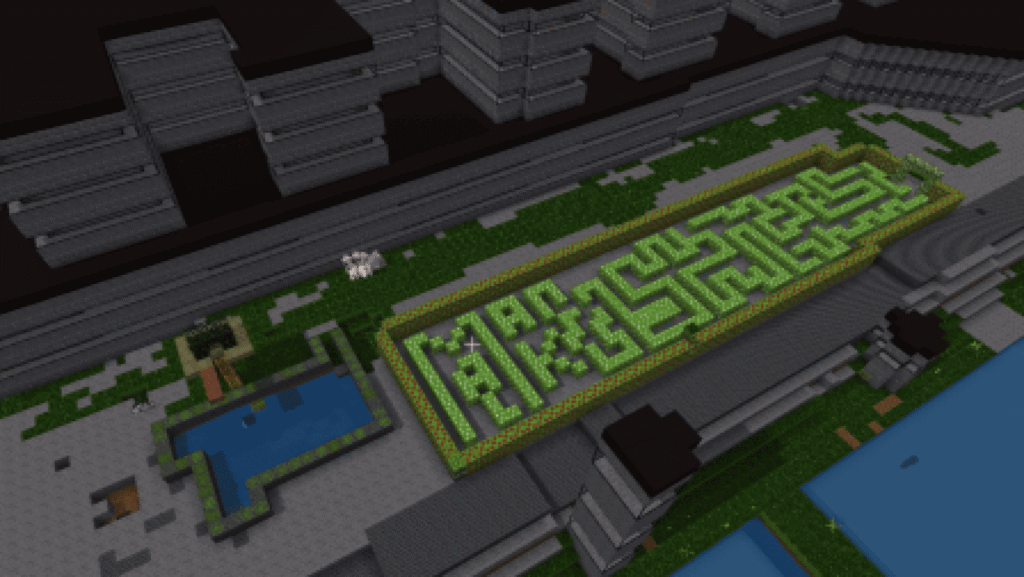
Figure 1 : maze garden
In other cases, we see a wonderful bond between parents and children, who sometimes discover each other in a new light. The parent asks the child how they might create something, and the child guides them. They take turns creating or work together simultaneously to produce a collaborative creation through play. The child takes the lead in the building process, but the result is very much a joint effort.
As with any learning process, accidents happen and lead to happy accidents, and it was the case with the waterfall (figure 2). After building a tower, a child wanted to add lava on top. It quickly spread, covering everything. To stop the destruction, an adult came to the rescue by pouring water to halt the lava. This accident thus transformed the tower into a large waterfall.
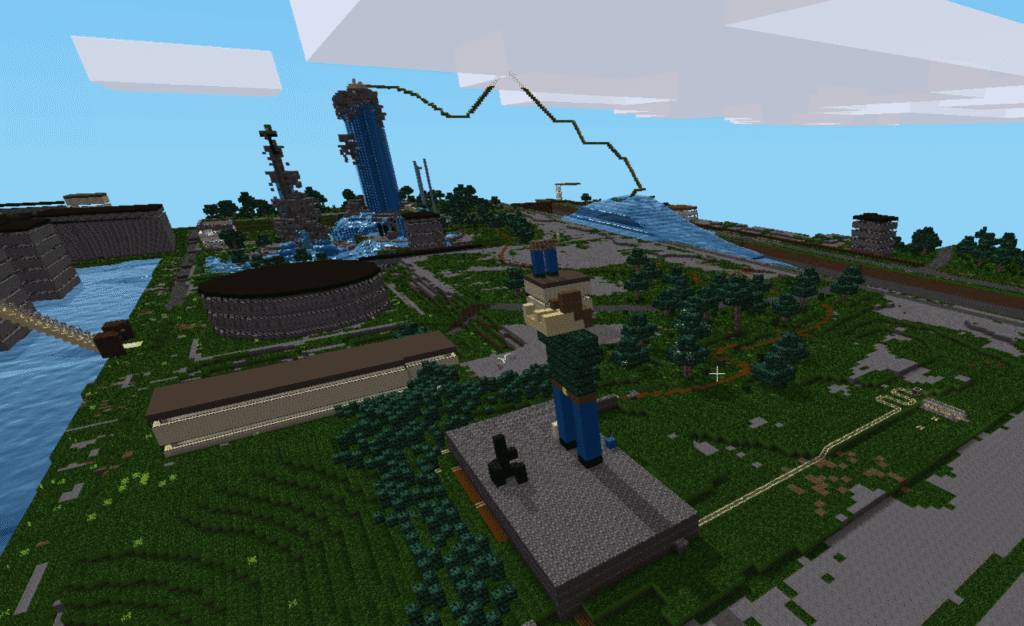
Figure 2 : waterfall
Ultimately, the feedback is unanimous. Parents feel a sense of pride when presenting the creations they have made together with their children. Some have even mentioned wanting to download Luanti, but only under the condition that it involves co-playing.
In short, the UrbanCraft workshops demonstrate that video games, when conceived as a space for co-individuation rather than as an object of surveillance, become a mechanism for mutual empowerment. What we observed in the parent-child relationship is not unique to the family setting: the reversal of the roles of expert and learner, camaraderie, shared pride, a desire to continue playing together, etc. These are the effects of a structure involving a shared constraint, an open environment and an asymmetry of skills that distributes the floor and the initiative. This structure is transferable to any adult-child relationship characterised by a power asymmetry, whether in a teacher-pupil, facilitator-group or cultural mediator-visitor relationship. Thus, the video game becomes a medium in which an intergenerational, collaborative pedagogy unfolds. Engaging with this medium through co-playing guided by shared learning opens up a path towards resolving the pharmacology of the screen.
Sources
Boissière, M.-C. 2023. Jeu et développement chez l’enfant. Paris: C&F Éditions.
Clark, L. S. 2011. “Parental Mediation Theory for the Digital Age.” Communication Theory.
Blewitt, C., O’Connor, A., Morris, H., Mousa, A., Bergmeier H., Nolan A., Jackson K., Barrett H., Skouteris H. 2020. “Do Curriculum-Based Social and Emotional Learning Programs in Early Childhood Education and Care Strengthen Teacher Outcomes? A Systematic Literature Review”, International Journal of Environmental Research and Public Health 17, no. 3: 1049.
Ewin, C. A., Reupert, A. E., McLean, L. A., & Ewin, C. J. 2021. “The Impact of Joint Media Engagement on Parent–Child Interactions: A Systematic Review.” Human Behavior & Emerging Technologies.
European Game Developers Federation, and Video Games Europe. 2024. Annual Report.
Inter‑Agency Network for Education in Emergencies (INEE). 2016. “INEE Background Paper on Psychosocial Support and Social & Emotional Learning for Children & Youth.”
Kim, J., Hwang, J. 2025. “Lessons from ‘Co‑Play’ in Korean Parent‑Child Relationships.”
Sobel, K., A. Bhattacharya, A. Hiniker, J. H. Lee, J. A. Kientz, and J. C. Yip. 2017. “It Wasn’t Really about the Pokémon: Parents’ Perspectives on a Location‑Based Mobile Game.” In Proceedings of the 2017 CHI Conference on Human Factors in Computing Systems.
Steinkuehler, C. A., Williams, D. 2006. “Where Everybody Knows Your (Screen) Name: Online Games as ‘Third Places.’” Journal of Computer‑Mediated Communication.
Stiegler, B. 1998. “Temps et individuations technique, psychique et collective dans l’œuvre de Simondon.” Intellectica.
Winnicott, D. W. 1971. Playing and Reality. London: Tavistock Publications.