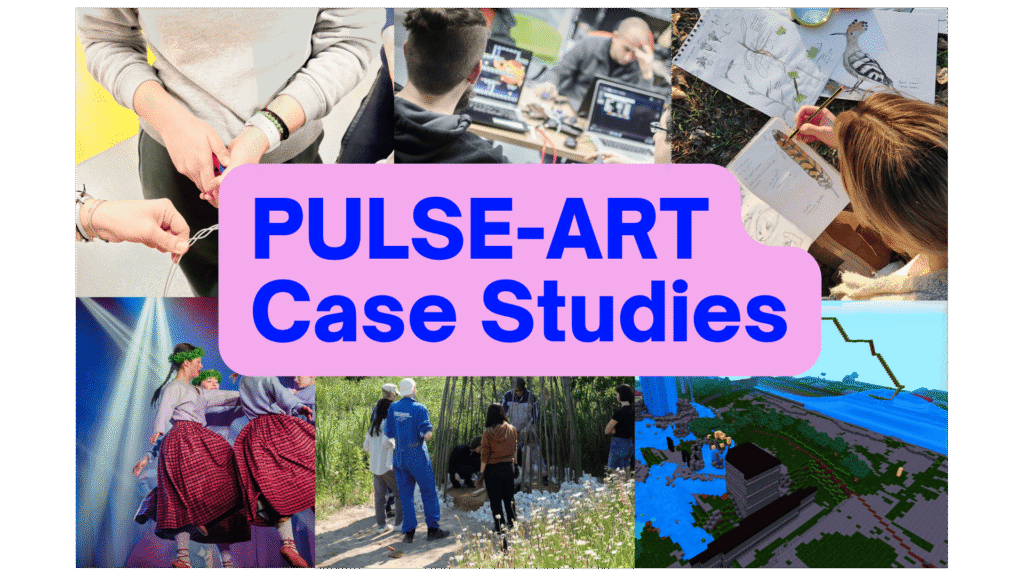
Source: Claudia Sanz, ISGlobal
Written by Claudia Sanz, ISGlobal
October 6, 2026
In PULSE-ART, arts-based learning is asked to do more than produce creative outcomes.
Through our case studies, we are not simply testing artistic practices in educational contexts. We are entering a space where art meets memory, belonging and imagination, and where participants are invited to explore complex research questions through creative practice.
Can dance help us express what is difficult to say about the past of our city?
Can music bring forward memories and identities that have often been pushed aside?
Can drawing help us rethink what counts as knowledge?
Can video games help us reframe the history of our neighbourhoods?
Cultural Awareness and Expression (CAE) can not be developed by approaching cultural diversity as something distant or already resolved. CAE flourishes when learners are invited to engage with culture as something living, situated and sometimes contested. It emerges through making, listening, mapping, drawing, dancing, coding, singing, negotiating and reflecting.
This is the shared ambition behind the PULSE-ART case studies. Each one takes place in a specific territory, with its own histories, inequalities, institutions, communities and artistic languages. Together, they form a constellation of experiments in arts-based learning: seven situated attempts to engage with culture as a living material, activated and transformed by young people as authors, interpreters and co-creators of meaning.
Let’s take a closer look at each of them.
Visual Tech Art and Interactive Heritage Mapping with Youth in Thessaloniki
Every city carries traces of what has been remembered, celebrated, erased or pushed to the edges of collective memory.
In Thessaloniki, secondary school and university students are co-creating an interactive 3D scale model of the city. The model includes NFC tags that connect physical landmarks to digital narratives, bringing together heritage, technology and storytelling to explore how a city with multiple cultural layers can be represented without reducing it to a single identity.
Thessaloniki is shaped by Byzantine, Ottoman, Sephardic Jewish, Romani and modern Greek histories. Its urban landscape carries traces of successive civilisations, although dominant narratives have often privileged one version of the city’s past. Choosing six culturally significant landmarks therefore becomes an exercise in interpretation and responsibility. It asks students to consider what deserves attention, which communities are made visible and how to approach stories that may be complex, uncomfortable or partially erased.
Through Visual Tech Art, students select, research and narrate their city’s heritage. As the physical model takes shape, technology helps open different layers of the city to dialogue, reshaping the stories a city tells about itself.
Daugavpils in Motion – Our City, Our Story
Daugavpils, Latvia’s second-largest city, is located in the south-eastern part of the country, close to the eastern border of the European Union. It is culturally diverse, economically challenged and shaped by complex narratives of identity and belonging. Social life can remain divided into homogeneous “bubbles”, limiting dialogue, civic engagement and intercultural exchange.
In this context, the case study uses dance, dance theatre and music to explore the city’s history, diversity and emotional landscape. Dance is approached as a shared language, capable of carrying what may be difficult to express through words alone.
The process unfolds through a symbolic structure of Dawn, Light, Darkness and Rebirth. These stages guide participants through presence, loss, transformation, resilience, hope and collective life.
At the heart of this case study lies the challenge of belonging in a fragmented territory.
Through co-creation, young people experiment with individual and collective expression and dance becomes a temporary space where tensions can be felt, explored and transformed through movement.
Young Voices, Living Roots: Co-Creating Music in Morocco
Some knowledge is carried through books, institutions and formal curricula. Other forms of knowledge travel through songs, stories, gestures, memories and oral traditions.
Young Voices, Living Roots works with young people across urban and rural contexts, including Marrakech, Rabat, Tinghir and Khénifra. The case study centres on Amazigh oral heritage, storytelling and collective music-making, opening a space to reflect on whose cultural knowledge is recognised, transmitted and valued.
Amazigh heritage has historically been marginalised within institutional and educational narratives, despite its central place in Morocco’s cultural landscape. Rural areas often play a key role in preserving oral heritage and traditional artistic practices, while receiving fewer resources and less visibility than large urban centres.
The project approaches music as a shared cultural language through listening circles, storytelling prompts, rhythm, voice, body percussion, lyric writing and collective composition. Facilitation in Tamazight, Darija and French allows cultural expression to move across languages and territories, connecting personal experience with collective heritage.
Traditional Amazigh musical forms are treated as living practices that can be reinterpreted, transformed and carried forward through contemporary artistic experimentation. Rather than placing heritage in the past, the case study invites young people to work with it as material for dialogue, creativity and belonging.
Art and science in a shared space: young people illustrating knowledge in Madrid
This case study takes place in Madrid’s “Science District”, an area where the National Museum of Natural Sciences, the Higher Technical School of Industrial Engineering, the Student Residence, the Spanish National Research Council and the Ramiro de Maeztu Secondary School coexist within walking distance. Despite their proximity, these institutions have often operated separately, reinforcing divisions between formal and non-formal education, research, culture and community.
The project uses scientific illustration to create new connections across this fragmented landscape. Over five sessions, high school learners explore the relationship between art, science and heritage through observation, drawing, dialogue and collective reflection. The process begins with a discovery phase, including visual activities and an interactive tour between the museum and the engineering school, where participants are introduced to different ways of producing and communicating knowledge.
A workbook inspired by field notebooks and diaries becomes one of the central tools of the process. Through it, students record personal interpretations of the places, objects and ideas they come across, expressing their own understanding of the environment.
As the sessions unfold, artistic practice is combined with critical reflection on how knowledge is represented, which cultural narratives become visible and how historical and social contexts shape our interpretation of science and heritage.
Drawing is used as an accessible tool that can reduce linguistic and cultural barriers. It creates a fertile ground for CAE, helping learners connect scientific observation with identity, experience and territory.
All Earth is your motherland
We often ask learners to write, measure and communicate what they know. Yet many educational experiences begin elsewhere: in the body, in the memory, in the way a place is felt before it can be described.
This case study takes place at De Zeehoeve, a farm on the edge of Amsterdam, between urban expansion and ecological land. Artist Rosalie Bak works with young people aged 16–27, many of whom are distant from the labour market, have left formal education or are navigating complex social transitions.
The farm is an active part of the methodology. It offers participants a tangible setting in which to explore belonging. For young people whose relationships to land may have been shaped by migration, urban life or social exclusion, the site becomes a place where personal memory, cultural identity and ecological experience can meet.
The process begins with sensing the ground. Participants walk, observe, touch, listen and attune themselves to the farm environment. Soil becomes an ecological reality and a metaphor for roots, movement, interdependence and displacement. Through somatic, visual and performative practices, participants explore their eco-cultural identity.
This case study reflects on what the body knows before it can explain. It also recognises that meaningful participation depends on trust. Many participants have moved through institutions where their knowledge, forms of expression or life trajectories were not fully recognised. The methodology therefore creates a safe space where sensing, remembering and expressing can become part of the learning process.
The Shift: Video Games Art Practices with Youth in the Paris Region
Digital tools are often framed in education as either a risk to manage or an innovation to celebrate. The Shift takes a different route by exploring digital creation as a space for cultural agency.
The project works with young people from peripheral urban territories, particularly Seine-Saint-Denis, alongside university students from central Paris. These territories are frequently described through deficit narratives linked to poverty, exclusion or insecurity, even though they are also spaces of intense cultural production and social transformation.
The case study uses video game environments to explore urbanity, future archaeology and cultural memory. Building on real places and local experiences, participants imagine fictional shifts that transform the territory across time, climate, culture or social life, and translate those changes into digital worlds.
In this process, the video game becomes a tool for asking who gets to imagine the future of a place, especially when that place is designed from the outside. By building “shifted” digital twins, participants create speculative environments where memory, social tension and possible futures can be explored collectively.
Clay modelling, photography, drawing and object creation are also part of the process before being transposed into digital environments. This opens participation beyond technical gaming skills and allows different forms of creativity to shape the final worlds.
Collaborative Game Design with Youth and Creative Communities in Malta
The project takes place at the Institute of Digital Games at the University of Malta, in collaboration with Heritage Malta. Young adults from diverse disciplinary and cultural backgrounds co-create digital games inspired by Maltese heritage collections. Malta’s history as a Mediterranean crossroads of cultural exchange, migration and colonial influence makes heritage a rich and complex field of exploration.
Game jams create a focused space for experimentation, collaboration and rapid prototyping. They also require careful facilitation, since technical expertise and digital fluency can shape the contributions.
The project addresses this by creating different ways to participate. Teams develop narratives, characters, visual environments, mechanics and soundscapes, using accessible tools such as Twine, Bitsy and GDevelop to lower technical barriers. In this way, cultural contribution is not limited to coding skills.
Heritage is approached as a living material that can be discussed through creative decisions. An artefact may become a character, a world, a rule, a sound or a choice. Each transformation invites participants to consider what the heritage object means, whose story it carries and how it changes when it enters a game environment.
The final showcase becomes a space for collective reflection, where participants present their games alongside the cultural choices embedded within them. In this case, CAE grows through dialogue, negotiation, decision-making and shared authorship.
What remains after the study
Across the seven PULSE-ART case studies, the arts become a way of staying with complexity. They allow young people and facilitators to approach questions that cannot always be answered quickly.
Much of the learning happens while participants make decisions together, negotiate meanings, deal with uncertainty and discover new ways of relating to a place, to a memory, or to each other.
This is where the PULSE-ART methodology gains depth. It is not only implemented across different contexts, it is challenged by them. Each case study brings its own conditions, limits and possibilities, helping the project understand how arts-based learning can respond to real cultural, social and educational landscapes.
What remains after this process is not a single definition of culture, nor a single model of how to teach it. What remains is a set of situated practices that show how young people can take part in shaping cultural meaning when the right conditions for trust, expression and collaboration are created.