A Programme rooted in purpose
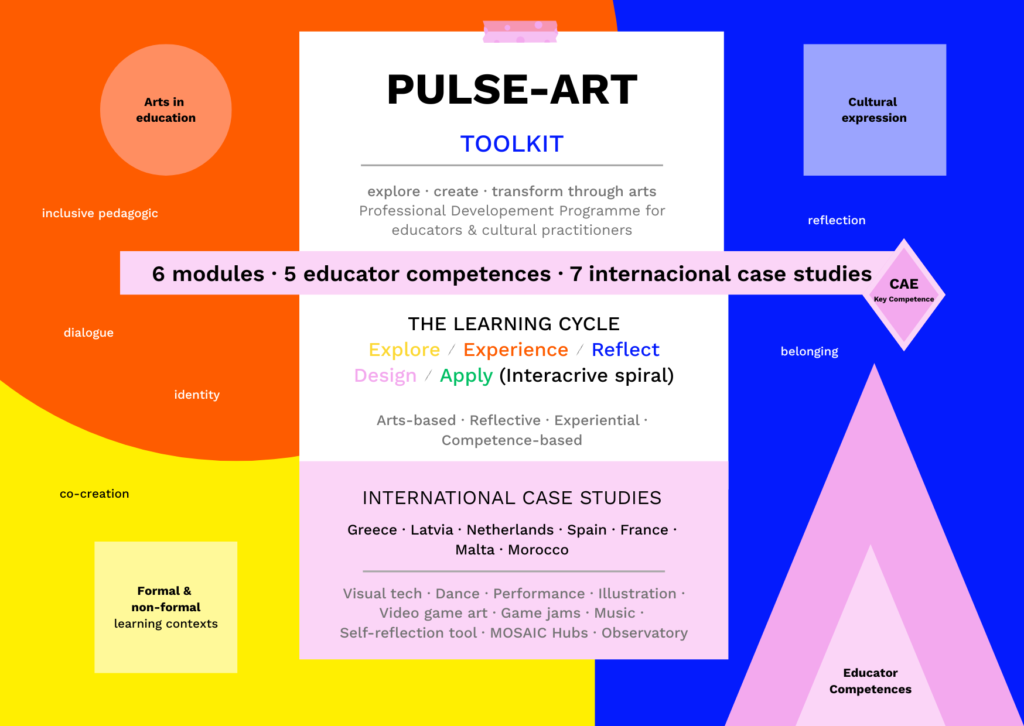
Image source: Designed by Eirini Tsichla in collaboration with ISGlobal
Written by Maria Kyriakidou, Iro Koliakou and Christos Aliprantis, Anatolia American University
June 2, 2026
The PULSE-ART Professional Development Programme (PDP) is an initiative designed to equip educators, cultural practitioners, and facilitators with the knowledge, skills, and attitudes needed to integrate arts into education in ways that meaningfully foster Cultural Awareness and Expression (CAE). The programme is built on a foundational conviction: that art is not simply a creative output, but a pedagogical process — a vehicle for reflection, dialogue, participation, and the exploration of identity and belonging. This conviction runs through the structural and methodological choices the PDP makes.
The programme addresses a wide professional audience, including educators working in formal settings, youth trainers, lifelong learning providers, and cultural facilitators in non-formal and informal contexts. It can be followed linearly as a comprehensive training journey or selectively, with individual modules/training chapters adopted according to context, experience, and learning needs. This flexibility is not incidental — it reflects a deliberate commitment to the same principles of adaptability and responsiveness that the programme asks educators to bring to their own classrooms.
The tool is currently undergoing a testing and validation process and it will be ready in a finalized form in the PULSE-ART Observatory after October 2026.
The Methodological Framework
At the heart of the PULSE-ART PDP is a cyclical learning logic, expressed in five interconnected phases: Explore → Experience → Reflect → Design → Apply. This cycle is not a linear progression but a spiral — educators are expected to return to earlier phases as their practice deepens, generating what the programme describes as iterative learning.
Each phase has a distinct character. In the Explore phase, educators are invited to interrogate their own assumptions about culture, art, and inclusivity, and to examine the cultural contexts and needs of their learners. This sets up a process that begins with the self, not with content. The Experience phase immerses educators in artistic practices directly — through storytelling, co-creation, and interdisciplinary activities — so that they encounter the processes they will later facilitate from the inside. The Reflect phase provides structured space to articulate insights, surface challenges, and name learning moments with clarity. The Design phase translates this embodied understanding into concrete learning activities adapted to each educator’s own context and goals. Finally, the Apply phase asks educators to implement, evaluate, and adapt what they have designed in live practice settings.
This cycle consciously mirrors the PULSE-ART umbrella methodology (described in project documentation as comprising stages of Discover, Create, and Reflect), and it aligns with a broader set of pedagogical commitments embedded throughout the programme. Arts-based reflection and storytelling, hands-on co-creation, inquiry-based and project-based learning, digital and technology-enhanced creation, formative assessment, and critical action planning are all recognised as essential pedagogical approaches. What unites them is an orientation toward experiential and embodied learning — the understanding that educators, like their learners, must engage cognitively, emotionally, and physically with the material in order to develop genuine, transferable competences.
The Modules at a Glance
The PDP is organised across six modules/training chapters, each following the Explore–Experience–Reflect–Design–Apply cycle and drawing on a shared structural template that includes contextual framing, an experiential artistic activity, guided reflection, and practical transfer to educational contexts.
Module 1: Introduction to Cultural Awareness and Expression through Arts Integration establishes its conceptual foundations. It maps personal and group cultural identities through storytelling, dialogue, and drama, and positions CAE as one of the EU’s eight key competences for lifelong learning. Educators explore how art can represent multiple perspectives and are introduced to the sociopolitical dimensions of identity and belonging.
Module 2: Foundations of Cultural Education broadens the lens to examine international models and policy frameworks — including UNESCO and EU guidelines — on arts in education. It compares formal and non-formal approaches globally and examines how creative scaffolding can support cross-cultural participation. Case studies such as the Micro-Folie digital museum in France and the Latvian School Bag programme illustrate how cultural heritage can be meaningfully integrated into educational settings.
Module 3: Practical Applications of the Arts shifts from foundations to hands-on practice. Through co-creation workshops, participatory performance methods (including approaches inspired by Theatre of the Oppressed), and peer feedback processes, educators engage directly with arts-based facilitation. The module emphasises creative risk-taking, accountability in collaborative spaces, and the importance of building shared values as a foundation for group artistic work.
Module 4: Technology for Arts in Education addresses digital creation, curation, and ethical use of technology as tools for cultural expression. It explores AI, immersive media, and digital storytelling, while also confronting the digital divide and questions of authorship and access.
Module 5: Assessment and Evaluation for Arts in Education challenges conventional assessment thinking and offers a holistic model in which process and product carry equal weight. It introduces culturally sensitive rubrics, portfolios, reflective journals, narrative self-assessments, and peer critique as legitimate and rigorous tools for capturing learning that resists standardisation.
Module 6: Reflection and Future Implementation closes the programme cycle by turning the lens on professional sustainability. Drawing on Action Research and Participatory Action Research frameworks, educators are guided through collective reflection on their learning journeys, co-design of implementation plans, and connection to the PULSE-ART MOSAIC Hubs and Observatory as communities of ongoing practice. The module does not simply consolidate what has been learned — it reframes learning itself as a continuous, socially embedded process.
Threaded across all six modules are seven international case studies — from Greece, Latvia, the Netherlands, Spain, France, Malta, and Morocco — covering visual technology, dance, performance art, scientific illustration, video game art, game jams, and music. These case studies function not as prescriptive models but as lived examples of how arts-based CAE education looks in practice across diverse cultural and institutional contexts.
The Competences We Wish to Achieve
A competence-based framework underpins this entire approach. The framework defines two interrelated and complementary sets of competences: Learner Competences and Educator Competences. Both frameworks are essential for a holistic approach to cultural education: while Learner Competences outline the knowledge, skills, and attitudes students should develop through arts-based cultural learning, Educator Competences define the pedagogical expertise needed to design and facilitate these learning experiences effectively. Rather than focusing exclusively on content knowledge, the PDP foregrounds practical, reflective, and relational competences.
Evaluation is conceived as formative and dialogical — valuing learning processes and meaning-making rather than fixed measurable outcomes. This is a significant methodological stance, particularly for a programme centred on arts-based education, where learning is often non-linear, affective, and resistant to standardised measurement.
The PDP is built around five educator competence clusters, each carefully linked to learner outcomes.
Designing Inclusive and Culturally Responsive Learning Environments (E1) centres on the educator’s ability to create learning environments that are genuinely accessible and welcoming for all learners.
Building Creative Processes (E2) develops the capacity to use artistic practices as genuine tools for inquiry, reflection, and dialogue.
Assessing cultural and arts-based learning (E3) supports the capacity to design assessment processes that cross subject boundaries, recognising culture as embedded in everyday knowledge systems rather than confined to dedicated arts classes.
Facilitating Intercultural Dialogue and Collaboration (E4) asks educators to examine cultural assumptions and values including their own, facilitate honest discussions around identity and difference, and model intercultural empathy in their professional practice.
Reflecting on Practice and Cultural Positionality (E5) builds the skill of embedding reflection throughout the entire learning process — using qualitative, creative, and participatory evaluation approaches, and continuously improving practice based on feedback and honest self-assessment.
When educators develop these competences, the programme’s expectation is that their learners, in turn, will develop corresponding abilities in creativity and reflection, cultural literacy and intercultural awareness, personal and shared cultural expression, and collective agency and social responsibility.
The Role of the Self-Reflection Tool
The self-reflection tool is one of the most distinctive features of the PULSE-ART PDP. It is not an add-on or an administrative requirement — it is structurally integrated into the programme’s learning logic and directly tied to the competence framework.
The tool consists of a questionnaire and comes in two versions: one for educators and one for learners. The educator version assesses five competence clusters (E1–E5) through questions that probe knowledge, skill, and attitude across concrete classroom situations. For each cluster, educators are invited to locate themselves on a developmental scale — Foundational, Intermediate, Advanced, or Expert — based not on abstract aspiration but on what they can actually demonstrate in their current practice. The questions are deliberately specific and behaviourally grounded. A question about inclusive design, for instance, does not ask whether the educator believes in inclusion in principle, but whether they can describe how they anticipate learner needs and adjust activities in real time.
Educators are encouraged to use the tool at three key moments: before engaging with modules (as a baseline), during or after artistic experiences, and following the application of new approaches in practice. This creates a longitudinal view of professional growth across the full programme.
The learner version maps four competence clusters — creativity and reflection, cultural literacy and intercultural awareness, personal and shared cultural expression, and collective agency and social responsibility (L1-L4) — using similarly concrete, situation-based questions. Both tools are designed to be experienced not as evaluation instruments in a summative sense, but as reflective mirrors: resources that help educators and learners articulate their growth, identify their strengths, and recognise where they still have room to develop.
After a testing and validation process, the PDP and the Self-Reflection Tool will be available in the PULSE-ART Observatory for Arts in Education, a digital platform with art-based education resources. Thus, the Self-Reflection Tool becomes not only a mechanism for individual development, but a building block of the broader communities of practice that the PULSE-ART project seeks to cultivate across Europe and beyond.
__________
Dr. Maria Kyriakidou is Chair of the School of Humanities and Social Sciences at the Anatolia American University, where she has taught Greek history, politics, and gender studies since 1997. She holds a PhD in Modern Greek Studies from King’s College London and has published extensively on gendered approaches to democracy and women’s studies. Her work focuses on the intersection of culture, history, politics, and gender in contemporary Greek society, as well as on issues of inclusion and diversity, contributing to both national and international academic discourse.
Dr. Iro Koliakou is Head of STEM at Anatolia College, where she leads interdisciplinary STEM and STEAM education from kindergarten through high school. She holds a PhD in Biomedical Sciences with expertise in physics and regenerative medicine, coordinating multiple EU-funded projects on sustainability, AI, and gender equity in STEM. Her work focuses on inquiry-based, inclusive education that empowers students to become innovative problem-solvers and ethical leaders.
Dr. Christos Aliprantis is an Associate Professor of Political Science and International Relations, and Executive Director of the Michael and Kitty Dukakis Center for Public and Humanitarian Service at Anatolia American University in Thessaloniki, Greece. He studied history in Athens, Vienna, and Budapest, and holds a PhD in modern European history from the University of Cambridge