Unsettling Heritage and Memory Futures: Decolonial Trajectories Between Crisis and Possibility
17–19 June 2026 | University of Amsterdam
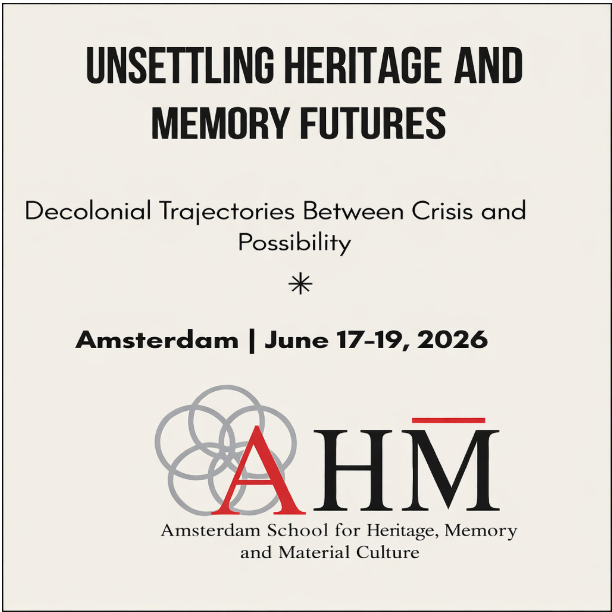
Image source: AHM Conference 2026
 Written and recommended by
Francisca Casas-Cordero, Outreach Technician at ISGlobal
March 3, 2026
The Amsterdam School for Heritage, Memory and Material Culture (AHM) invites scholars, artists, practitioners, and activists to submit proposals for its 2026 annual conference, focused on decolonial approaches to heritage, memory, and material culture.
The conference examines how decolonial practices have reshaped museums, memory politics, and restitution processes, while addressing current challenges posed by resurgent nationalisms and neocolonial dynamics. Contributions may take the form of individual papers, panels, or roundtables engaging theory and practice around themes such as cultural justice, contested memories, digital heritage, and community participation. Projects integrating art, education, and critical pedagogical methodologies in dialogue with communities are especially welcome.
Submission deadline: 27 March 2026 (CET)
Full call and details:
https://aihr.uva.nl/content/news/2025/11/cfp-ahm-conference-2026.html
Organised by the Amsterdam School for Heritage, Memory and Material Culture (AHM), the Dutch Research Council (NWO), and ACASA.
What is the connection with CAE?This event is clearly aligned with the priorities promoted by PULSE-ART and the core vision of CAE at the European level: cultural democracy, epistemic justice and transformation of cultural policies. The conference welcomes contributions from researchers, professionals, artists, activists, and civil society organisations, fostering an interdisciplinary dialogue that bridges theory and practice. It also represents a significant opportunity to present educational and artistic projects grounded in critical and collaborative methodologies. In this sense, it offers a strategic space to connect theoretical reflection, concrete institutional experiences, and European cultural agendas around decoloniality. |