Written by Nella Escala (SFC), Marine Masson (PULSE-ART Project Coordinator, SFC), and María Ruiz de Cossío (EMEA)
October 6, 2026
Collaboration is an important part of PULSE-ART. Beyond the work within its own consortium, the project connects with sister projects and other European initiatives to exchange knowledge, explore common challenges, and strengthen the impact of arts and culture in education.
PULSE-ART is already working with sister projects such as ALPHABETICA, INTRACOMP and TOWCHED, funded under the same Horizon Europe call (2024-2028). Therefore, they share common interests around arts-based education, cultural awareness, inclusion, youth participation, impact assessment and policy development. But what can projects learn from each other when they are working on similar challenges? How can they join forces to achieve stronger, longer and deeper rooted impact?
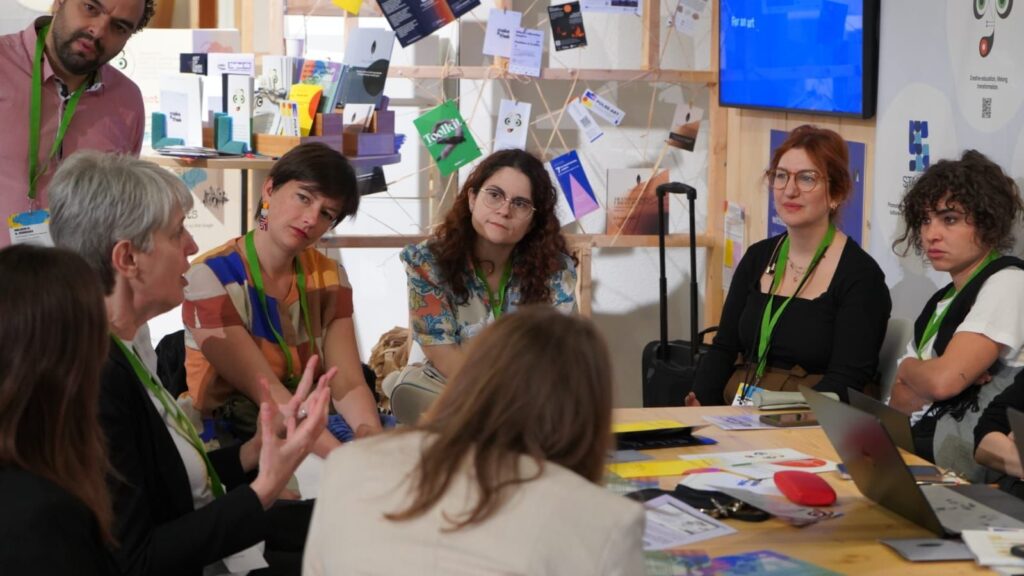
Source: Eider Olazar Elduaien (Elhuyar), ALPHABETICA project
Creating spaces for exchange. Some of the ideas discussed between the PULSE-ART sister projects include impact assessment and professional development approaches, connecting policy activities, linking cultural hubs, and creating joint dissemination and mutual learning opportunities. These exchanges can help projects to understand what works in different contexts, identify where methodologies can complement each other, and how results can reach further.
To date, the sister projects have met in various circumstances, including at European and international events such as MONDIACULT 2025 and the NEB Festival 2026, as well as at their own events, such as PULSE-ART’s first Spanish MOSAIC HUB / “Layers of Values” event, and TOWCHED’s “Juventud en la Encrucijada” event in 2025. They also met on a more regular basis online.
The primary purpose of the coordinators’ online meetings, which used Miro as a visual collaboration tool, was to map out shared objectives, project outcomes, and challenges across respective timelines. Building on these exchanges, additional in-person and virtual meetings were held—depending on feasibility, given that coordinators are based across Italy, Spain, and New Zealand—to examine similar outcomes and challenges in greater detail. For example, the CultureComp Framework (INTRACOMP) was compared with the PULSE-ART Competence Framework. Furthermore, a dialogue organized by their shared Project Officer, Nikoleta Giannoutsou, and the European Commission policy officers on the 20th of March, 2026, provided project coordinators with a valuable opportunity to discuss policy objectives and perspectives.
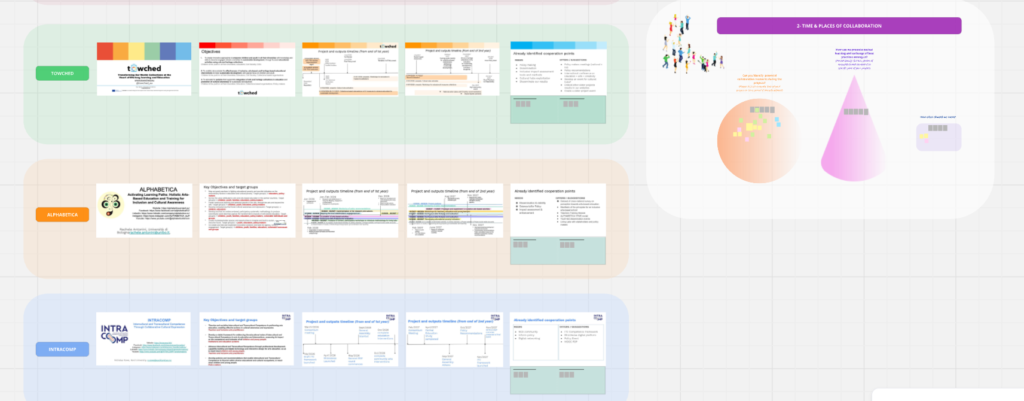
Source: MIRO board of one of the online meetings with the PULSE-ART sister projects.
To strengthen collaboration, cross-project task forces were established to connect consortium members working on similar deliverables. These groups set up regular meetings to coordinate joint efforts, particularly in communication, dissemination, and professional development programmes. With the projects advancing and yielding results, there is a shared ambition across partners and coordinators to work more closely together—an opportunity that is both timely and essential.
PULSE-ART is also part of NEBULE, a cluster bringing together 10 Horizon Europe projects connected to the values and principles of the New European Bauhaus (NEB). With a shared focus on co-creation, the cluster explores how research, arts, culture, heritage, design, and community participation can contribute to more inclusive, sustainable, and meaningful environments and learning experiences. PULSE-ART contributes to this collective reflection through its work on arts-based learning, Cultural Awareness and Expression (CAE), participatory methodologies and policy dialogue.
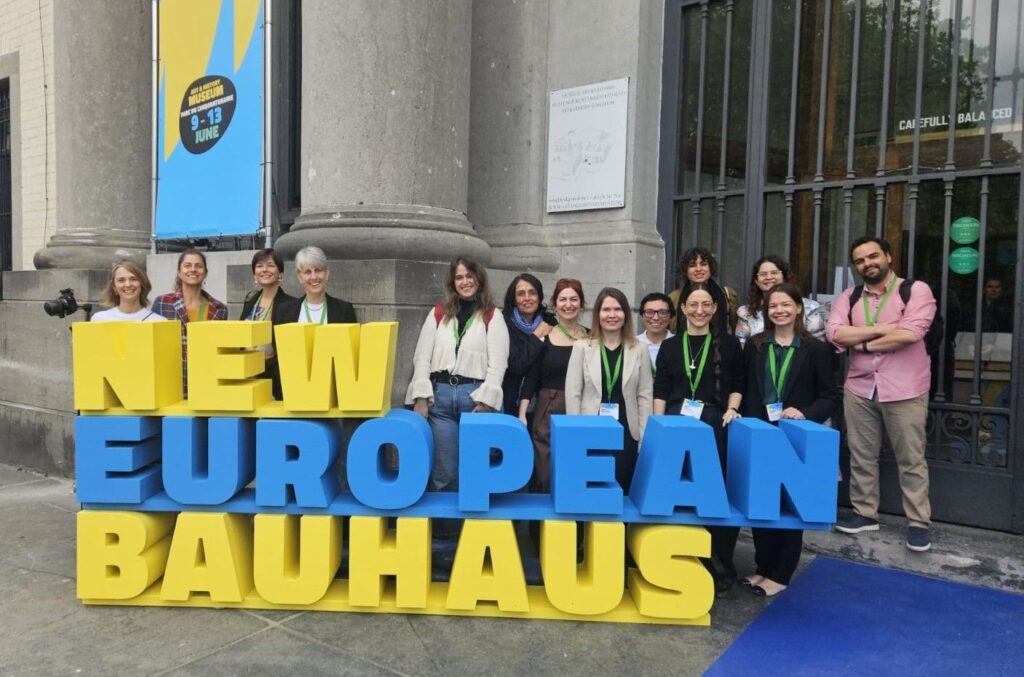
Source: NEBULE partners during the NEB Festival, Brussels, June 2026.
Engagement with the wider NEB community is an integral part of PULSE-ART’s activities. Throughout the project, PULSE-ART will organise three dedicated networking events with NEB projects and stakeholders, creating opportunities to exchange experiences, identify synergies and explore how approaches developed across different initiatives can reinforce one another. The first of these networking events took place in September 2025, establishing an early space for dialogue between PULSE-ART and other projects working around the NEB.
Another important milestone was PULSE-ART’s participation in the NEB Festival in Brussels alongside its NEBULE partners in June 2026. The Festival offered a valuable opportunity to present the project within the broader NEB community, connect with researchers, cultural and creative actors, policymakers and other practitioners, and exchange perspectives on co-creation as a core principle for developing more inclusive and participatory initiatives. Through the joint NEBULE presence, PULSE-ART also positioned arts-based education and CAE within wider conversations on the role of culture, creativity and participation in shaping the NEB.
These interactions are not only opportunities for dissemination. They also create channels through which PULSE-ART can bring external perspectives into its own activities, connect its emerging methodologies and results with complementary initiatives, and strengthen the networks that can support their uptake beyond the project’s lifetime. In this way, engagement with NEBULE and the wider NEB community contributes to both mutual learning and the longer-term sustainability and exploitation of PULSE-ART results.
These collaborations create spaces to exchange ideas, learn from other projects and contexts, and discover new ways to make project results more useful and visible, as through PULSE-ART participation in Heritact’s final event roundtable on inclusion (Open NEB Day, 2026). Because when projects share what works, what does not, and what they are learning along the way, their impact can travel much further.
PULSE-ART is open to new connections with projects working across education, arts and culture. Get in touch to exchange ideas, share experiences or explore new opportunities for collaboration, and discover the PULSE-ART Observatory for Arts in Education as a space to connect with related initiatives!